On Thanksgiving day, a close relative of mine was talking about her son and she nonchalantly stated, “Well, you know, my son doesn’t believe in Jesus…” Now, I knew that she and her family had drifted from organized religion for various reasons – some reasons that we, as church, have solidly earned. But I hadn’t realized that the baby (Jesus) had been thrown out with the bathwater! Her comment made belief in Jesus sound so passé… so “last week.”
What I gathered was that she and her son were now theists; in her words, they are “spiritual, not religious.” They are people who believe in God, but just think of Jesus as another gifted spiritual leader, and, in today’s culture, surely, she and her son are not alone.
In some ways, I don’t think this is an unusual progression for spiritually maturing people. It’s right and good that we seek and foster what’s common among all the great religious traditions and promote what unites us rather than what divides. To respect another’s religious tradition is a no-brainer for people of peace and goodwill. But her comment got me thinking – what IS distinctive about being a Christian anyway? Not in a judgmental, “circle-the-wagons,” exclusionary kind of way, but simply asking “Why Jesus?”
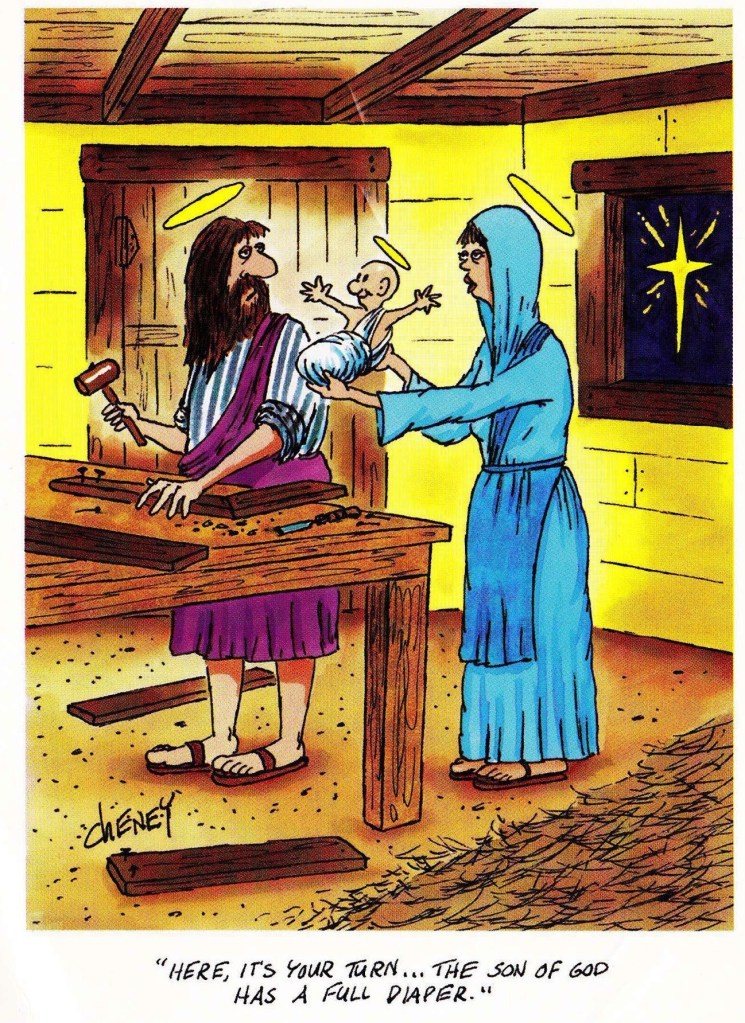
The Gospel readings we hear during Advent and Christmas season highlight both a main stumbling block for the modern mind – namely, the virgin birth – while also presenting what I would deem the most compelling mystery of Christian Spirituality – the Incarnation. I received a Christmas Card last year that captured both these beliefs perfectly. It showed Mother Mary handing the baby Jesus over to Joseph with the caption “Here, the Son of God needs a diaper change.” What could be a better example of God becoming truly human, mixing the divine and all that is earthly, than a baby needing a diaper change?
So, first, the virgin birth first. I get it. It’s quite a leap. But shouldn’t the actions and reality of God boggle our minds? Our bodies in and of themselves are walking miracles. With all the complexity of reproduction and the intricate timing necessary for conception, the fact that ANYONE gets pregnant at all is a bit of a miracle. If we could grasp everything about God, then God wouldn’t be worthy of being God. Some scripture scholars say that all that’s really being conveyed in referring to Mary with the ancient greek word translated into our english word “virgin” is to indicate that she was among the most vulnerable and powerless people in the ancient world; a young, single woman of marrying age.
In the end I can only speak for myself and truth be told, if tomorrow it was somehow proven beyond a doubt that Mary conceived in the usual way, it would have little effect on my faith in Jesus. The virgin birth is not a deal breaker for me either way. COULD God do it? Yes, of course. The creator of the universe can do lots of things we might not understand or believe as possible. Did Jesus’ conception and birth happen in this way? This question is a matter of faith not reason, and though our faith never negates or goes against reason, it does occasionally transcend it. (For a deeper exploration of this topic, visit Dr. Marcus Borg’s blog at THIS LINK)
But I’ll tell you what IS a deal breaker (again, at least for me); Our foundational belief in the incarnation. THIS doctrine is absolute bedrock for me.
In 100 words or less, we think of the incarnation this way (ala, my favorite, Rolheiser); in the beginning God created the world and everything in it, concluding with humanity. But humanity soon strayed and God, in His mercy decided to send His Son, as an infant, who was God but also fully human, to be with us in our own history to show us the way. Jesus was with us for 33 years revealing God’s nature, teaching great truths, healing people, working miracles, but was eventually falsely accused, arrested, crucified, and died. He rose from the dead, spent some time helping his disciples adjust to this new reality, and then ascended into heaven. But, the story does not end there. We don’t believe that the incarnation is something that began in Bethlehem and ended on the cross. Rather, we believe the incarnation continues in us. Jesus’ Body now on earth is US. When St. Paul calls us the Body of Christ, he isn’t speaking metaphorically, saying we “symbolize” or “resemble” Christ. Our scriptures simply say that WE ARE the body of Christ, now, physically, concretely, continuing God’s mission.
As St. Teresa of Ávila says, “Christ has no body but yours, no hands, no feet on earth but yours, yours are the eyes with which He looks compassion on this world, yours are the feet with which He walks to do good, yours are the hands, with which He blesses all the world.” This is not only our defining Christian doctrine of the Incarnation, but it is also the belief that gets me out of bed in the morning.
Fr. Greg Boyle points out that within the song “O Holy Night” we sing “Long lay the world in sin and error pining, until He appeared, and the soul felt its worth.” This song is of course about Jesus and the Christmas story, but it is also about OUR job description as Christians – as the on-going incarnation in the world today; our calling to take seriously all that Jesus took seriously: Inclusion, unconditional loving kindness, non-violence, and compassionate acceptance so that we can BE in the world that which “appears” and “souls feel their worth” in our presence; to BE the Body and concrete presence of Christ (thump…bedrock).
John’s gospel opens with this central belief when he says, “The Word became flesh.” The author of John had two choices for the Greek word translated as flesh: Sarx & Soma. Soma was used when referring to the human body in a postive way. Sarx on the other hand was always used when referring to the less attractive aspects of the human body. So, we are “soma” when we are healthy, hopeful, and virtuous and we are sarx/flesh when we get sick, have body odor, make bad choices and suffer death. John’s opening verse notably uses the word sarx. “…and The Word became Sarx” – the vulnerable, smelly, not so polished version of our humanity is what God became for us.
Jesus says to us, His followers, “If you do not eat of the flesh of the Son of God you will have no life within you.” Again, sarx is used here, so Jesus is not talking about his divine nature, and he is not referring our Eucharistic bread. The flesh (sarx) body of Christ he is talking about is us. In essence Jesus is saying if you can’t take part in THIS, my body, this messy, broken, neurotic, less-than-perfect community that I have gathered, then you will have no life within you. It is simply impossible to be a Christian alone.
The mystery of the incarnation says that we participate in the flow of God’s life (the sap in the true vine that flows to the branches) when we partake in the ordinary, everyday, give and take of relationships. This is how we are invited to participate in God’s divinity – by hanging together. “By this everyone will know that you are my disciples, if you love one another” (John 13:35). When we listen, forgive, show tenderness, break bread together “in His memory” even when we disagree or don’t “feel like it” – this is how we bear witness; this is the way we most effectively preach and promote the spread of God’s presence.
It’s notable that the way to God in many religious traditions involves escaping the physical and transcending the mess of “the world” in the name of the spiritual. One metaphor I’ve heard is that we (humans from all the different religious traditions) are all traveling up the same mountain on different paths to the same God.
But what makes Christianity distinctive is that WE don’t travel UP the mountain to find God but rather God comes DOWN from the mountain to find us. What is uniquely beautiful about Christianity is God’s choice to blaze a path to US – to come “be with us” (what the word Emmanuel means) – to reveal and communicate with us through the messy, earthly, painful act of childbirth. God saw His GOOD creation going astray and took the initiative (pardon the pronouns). It is not we who travel to God, but God comes to be with us, to show us the way. In Jesus, God humbles Himself and joins us right here in our very own history. Incarnation literally means “in body.” We are simply bid to recognize God’s presence among us in this gift and sacrament of the person of Jesus. As our 2nd century church father Athanasius once said, “God became man so that we might become divine.” Has there ever been a more lovely belief?
Some theologians say that the first and primary claim of the gospel is not, as we often think, that “Jesus died for our sins.” Nor is it, as we are sometimes told, “God loves us and has a wonderful plan for our lives.” Rather, the first and primary claim of the gospel is, “God is here.” Our Doctrine of the Incarnation states that God has taken on human flesh: in the person of Jesus, in the Eucharist, and in all who are sincere in faith as the body of Christ.
(I heard or read this little illustration somewhere, but Lord forgive me, I don’t remember from who). There is a story of a boy who receives the gift of a fish from his mother, and he loves this fish so much that he saves his allowance for weeks and weeks to buy the fish a little bridge to swim under. But no matter what the boy does; yelling at the fishbowl, making signs, and drawing pictures for the fish, etc. the fish just won’t swim under the bridge! So, the boy says to his mom in frustration “Mom, why can’t I teach the fish to swim under the bridge?” And the mom replies “Oh honey, in order to teach the fish to swim under the bridge, you would have to become a fish yourself.” Not an exact metaphor of course, but insightful. God simply could not bear the alienation that our bad choices and sin had caused so Jesus came among us, to save us, and show us the way home.
We do not believe in a God somewhere “out there,” or “up there,” transcendent and aloof towards us. Rather, we believe in a God who humbled himself to walk the earth with us and who is still physically present to us in a simple meal of bread and wine shared among us, and inside each and every human being that lives. The Christian God can be seen, heard, felt, tasted, and smelled through the senses.
John Shea writes a little story that highlights the power in this belief….
“She was five years old, sure of the facts, and recited them with slow solemnity, convinced every word was revelation. She said they were so poor that they had only peanut butter and jelly sandwiches to eat, and they went a long way from home without getting lost. The lady rode a donkey, The man walked, and the baby was inside the lady.
They had to stay in a stable with an ox and an ass (tee – hee) but the three Rich Men found them because a star lighted the roof! Shepherds came and you could pet the sheep, but not feed them. Then the baby was borned! And do you know who he was? Her quarter eyes inflated to silver dollars. The baby was GOD!
And she jumped in the air, whirled around, dove into the sofa, and buried her head under the cushion…Which is, of course, the only proper response to the Good News of the Incarnation.”
 STRONG LANGUAGE:
Oh Lisa, your words are inspired and inspiring. Thank you for sharing your gifts and giving me wisdom to ponder and grow with❤️
LikeLike
You are always so encouraging Julie 🙂 Love ya pal
LikeLike
Lisa, I looked up* the Greek SARX. It has at least 4 meanings. None was close to your definition of Jesus’ sarx. Interesting. *Biblestudytools.com
Can you comment? Thanks.
LikeLike
Sure – What sentence(s) from this piece about the “definition of Jesus’ sarx” are you referring to? I am happy to look up the reference. It was from some of my old notes from waaaay back in grad school, so it might take me a minute, but I’m delighted that someone is reading so closely and cares enough to write me a note 🙂 I did a quick, cursory google search and found most of the resources to be in line with what I wrote, so perhaps you could send me the piece you read on Biblestudytools.com that is conflicting? Thank you for your time and care.
LikeLike
Hi Lisa, I so enjoy your writings and have always been in awe of how the words just flow from you. I follow Fr Richard Rohr daily meditations. And this year is on prophets. I believe that you are a prophet and am so thankful that I have been blessed to know you and be able to read your in inspired words. God has blessed you and I keep you in prayer.Cathy Needham❤️
LikeLike
You are very generous Cathy 🙂 Thank you for your kind words.
LikeLike
Thank you so much for this beautiful sharing. It was a prayerful experience to read your thoughts on the Incarnation. I will continue to drop by and read and learn from you deep wisdom, and faith.
In Christ Jesus
Br. Mark Dohle
https://www.unexplained-mysteries.com/forum/blogs/blog/895-talking-to-myself/
LikeLike
Thanks Mark 🙂 Very kind of you to take the time to write this encouraging note. Blessings to you!
LikeLike